Baobab Fruit Powder: Why Food Futurists Call It the Most Important Superfood of Our Time
What if the solution to our broken food system has been growing in Africa for thousands of years? That question sounds dramatic until you understand how fragile global food supply has become — and how much nutritional and ecological potential sits in largely ignored plants like Baobab.
Right now, 75% of the world's food supply comes from just 12 plant species and 5 animal species. We have industrialized ourselves into an extraordinarily narrow nutritional corridor — one that is increasingly vulnerable to climate disruption, soil depletion, disease, and the cascading pressures of feeding a global population projected to reach 10 billion by 2050.
Food futurists, ecologists, and nutritionists agree: diversifying our food system is not optional. It is existential. And the path forward may run directly through the African savanna.
The food system of the future makes a lighter impression on the Earth. In many cases, agriculture will regenerate our planet — employing a harmonious balance of high-tech and traditional methods to address our greatest challenges.
The Problem With Eating the Same 12 Plants
Monoculture-dependent food systems are inherently fragile. When we rely on a tiny number of species — corn, wheat, soy, rice — we create an ecosystem of sameness that is uniquely vulnerable to the kind of shocks that climate change is already delivering with increasing regularity.
The Irish Potato Famine is the most cited historical example, but the dynamic is playing out in slower motion today. Soil degradation, aquifer depletion, and the collapse of pollinator populations are all downstream effects of industrial monoculture agriculture. The system works extraordinarily well in stable conditions. Stable conditions are becoming rarer.
Biodiversity is the hedge. When more plant species are cultivated, consumed, and economically valued, the food system becomes more resilient — less susceptible to any single point of failure. This is why food futurists are looking far beyond existing staple crops for what they call "new" foods.
 New, in this case, is a relative term. Baobab fruit powder is ancient — it has been a cornerstone of nutrition across sub-Saharan Africa for millennia. What is new is the Western world's awareness of it.
Why Baobab Is Uniquely Positioned for the Future
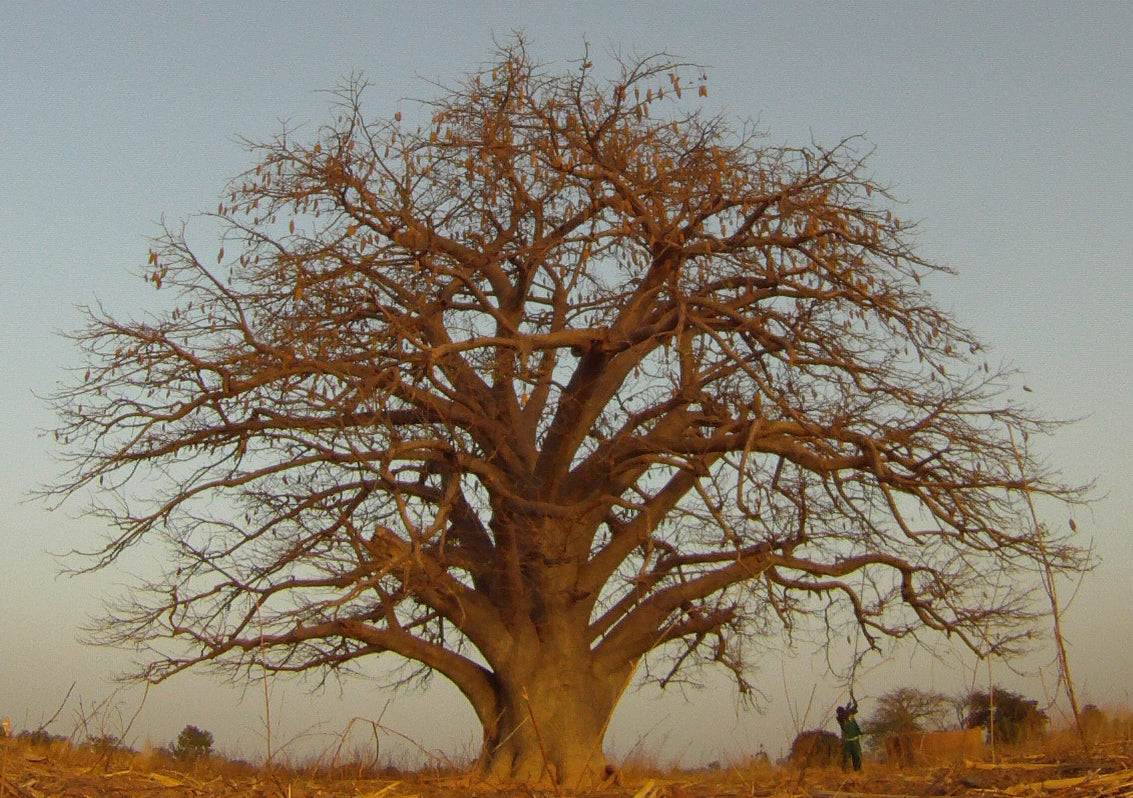
The Baobab tree (Adansonia digitata) is, by nearly every measure, one of the most extraordinary food-producing plants on earth. It grows wild across the African savanna without irrigation, without pesticides, and without human cultivation — in some of the most nutrient-depleted, drought-prone soil on the planet.
It is also one of the longest-living organisms on earth, with individual trees documented at over 1,000 years old. The Baobab does not just survive harsh conditions. It thrives in them.

This resilience is not incidental. It is encoded in the biology of the fruit the tree produces — and that biology translates directly into remarkable nutritional density.
Baobab Fruit Powder: Nutritional Snapshot
|
A food that requires no water input, no synthetic fertilizer, no monoculture infrastructure — and delivers this nutritional profile — is not just a health product. It is a genuinely sustainable food system asset.
The Gut Health Case: A Fiber Emergency
One of the defining nutritional crises of the modern Western diet is fiber deficiency. The average American consumes less than half the recommended daily fiber intake. The downstream effects are well documented: compromised gut microbiome diversity, elevated inflammatory markers, impaired immune function, blood sugar dysregulation, and accelerated metabolic decline.
Baobab fruit powder addresses this deficit in a way that few other foods can match. At 50% dietary fiber — 75% of which is prebiotic — it is not simply a high-fiber food. It is one of the most concentrated whole-food prebiotic sources available.
Prebiotic fiber feeds the beneficial bacterial colonies that form the foundation of microbiome health. When those bacteria ferment the fiber, they produce short-chain fatty acids — butyrate, propionate, and acetate — that nourish the gut lining, modulate immune response, and send satiety signals to the brain.
At the same time, Baobab's bitter polyphenols activate TAS2R receptors distributed throughout the gastrointestinal tract, triggering the secretion of GLP-1, PYY, and CCK — the hormones that regulate appetite, gastric emptying, and glucose metabolism. This is the same metabolic pathway being targeted by some of the most discussed pharmaceutical interventions of the past decade, present naturally in a wild African fruit.
Baobab delivers two distinct mechanisms simultaneously: polyphenols activating gut bitter receptors for metabolic signaling, and prebiotic fiber feeding the microbiome for gut health and satiety.
The Regenerative Supply Chain: Good for the Planet and Its People
The future of food is not just about what we eat. It is about how that food is grown, harvested, and brought to market — and who benefits along that chain.
Baobab fruit is wild-harvested by communities across sub-Saharan Africa. The trees require no planting, no irrigation, no chemical inputs. Harvest provides meaningful income to rural communities — predominantly women — in regions where economic opportunity is limited and land stewardship is generational.
KAIBAE has worked directly with harvesting communities in Northern Ghana since 2012, building traceable supply chains that generate sustainable livelihoods while incentivizing the conservation of wild Baobab populations. When Baobab has economic value, the trees have economic protection. Conservation and commerce become the same thing.

Why Baobab Is a Regenerative Food System Asset
|
An Old Food With a New Mission
There is something quietly radical about the argument that the food of the future already exists — that it has been growing in Africa for thousands of years, nourishing communities that understood its value long before nutritional science could explain it.
But that is precisely the case with Baobab. The research now validates what traditional use established centuries ago: this fruit supports gut health, metabolic balance, immune function, skin vitality, and sustained energy in ways that few foods can match. And it does so while requiring almost nothing from the earth to produce.
As food futurists map the path toward more sustainable, biodiverse, regenerative food systems, they are looking for ingredients that deliver nutritional density, ecological resilience, and supply chain integrity simultaneously. Baobab fruit powder is one of the clearest answers available.
At KAIBAE, we have spent more than a decade building the infrastructure to bring this ingredient to the people who need it most — while ensuring that the communities and ecosystems that produce it are protected and strengthened in the process. That is what a food system built for the future looks like.
The next chapter of the food system isn't waiting to be invented. It's waiting to be recognized — and brought to the people, tables, and communities who need it most. That's the work we're doing at KAIBAE. We'd love for you to be part of it.
Ready to experience Baobab? Add KAIBAE Baobab Fruit Powder to your daily routine. 👉 Shop Baobab Fruit Powder