KAIBAE 2025 Impact Report: How Baobab Harvest Continues To Power Communities
We are exceptionally proud to announce the release of The KAIBAE 2025 Impact Report!
Having spent the last 15 years building one of West Africa’s most reliable baobab supply chains, we wanted to pause and take stock of those efforts: Is KAIBAE having an impact with this work? What sort of value, if any, is being felt at the community level? To find out we headed into the field in Northern Ghana with some questions.
As in previous assessments, the team used participatory rural appraisal (PRA) methodologies to ensure that findings were defined and prioritized by community members themselves. Our impact assessment serves as a detailed account of KAIBAE’s journey and measurable progress over the five-year period spanning from 2020 to the present. The report is designed to offer our stakeholders, partners, and the wider community a transparent look into the direct, positive changes it facilitates.
A core finding of the report is the significant contribution and critical role played by the income generated from sustainable Baobab sourcing. We provide a clear, illustrative analysis comparing the revenue derived from Baobab to all other annual income sources, highlighting its growing importance as a foundational pillar of our economic model. Crucially, the report offers a transparent breakdown of exactly how these funds are directly utilized at the household level. This transparency underscores our commitment to a truly ethical and regenerative supply chain, demonstrating that KAIBAE is not just a business, but a genuine engine for community empowerment and ecological preservation.
Our commitment to the sustainable harvesting of baobab creates tangible, positive change for both people and the environment. This impact extends beyond building out a sustainable supply chain and providing vital economic stability and income for the local men and women who rely on the baobab harvest. By supporting KAIBAE, you directly help secure fair wages, foster community development, and ensure the long-term stewardship of critical baobab ecosystems. This work is transforming lives while simultaneously preserving biodiversity in the face of severe climatic and economic challenges.
Thank you for being a part of this important journey. Your dedication to KAIBAE's mission is not only deeply valued but is increasingly vital to the harvesting communities we partner with.
KAIBAE Impact Report 2025

KAIBAE revalues wild plants, considered Lost Crops, to protect biodiversity, improve livelihoods, and support total well-being.
Starting in 2012, KAIBAE pioneered the development of the baobab supply chain in the Upper East Region of Ghana. At that time, baobab was largely consumed at the household level, with only limited, informal market sales. Over more than a decade of partnership with local businesses and harvesting communities, KAIBAE has helped establish baobab as a reliable source of income, particularly during the dry season, and as an increasingly important contributor to household resilience.
In 2025, KAIBAE conducted a participatory impact assessment to better understand how livelihoods and income use have evolved since a previous impact assessment was conducted in 2020. The present assessment builds on those earlier findings and reflects changing environmental, economic, and food security conditions in northern Ghana.
Methodology
During the 2025 assessment, KAIBAE interviewed four community groups across the Upper East Region. As in previous assessments, the team used participatory rural appraisal (PRA) methodologies to ensure that findings were defined and prioritized by community members themselves.
Each group was asked two core questions:
-
What are the main sources of income within the community across the year?
-
What are the main things that this income supports at the household level?

Community members using PRA activity to demonstrate main sources of income
Group discussions highlighted significant nuance within and across communities, reflecting differences in seasonal conditions, market access, and household strategies. However, clear shared trends emerged when the results were analyzed collectively and compared to data from five years earlier.
Main Sources of Income

Across all four communities, baobab harvesting and sales were consistently identified as the most important source of income. As in 2020, baobab plays a particularly critical role during the dry season, when farming activities are limited and alternative income opportunities are scarce. Community members emphasized that baobab income provides cash at a time of year when households are most financially vulnerable.
One of the most notable changes since 2020 is the growing importance of farming- and subsequent sale of crops- as a source of income. While farming was present in earlier assessments, its relative importance has nearly doubled over the past five years. Community members explained that increasing financial pressures have forced many households to sell a larger share of their harvest rather than retaining crops solely for consumption or replanting the next year. This reflects both rising costs of living and reduced reliability of other income streams.

Basket weaving remains a steady source of income
Shea harvesting and processing remains an important livelihood activity, particularly for women, but participants reported a significant decline in its contribution to household income over the past three years. Poor shea tree harvests were consistently cited as the primary reason for this decline, aligning with emerging research suggesting increasing vulnerability of indigenous fruit trees to environmental and climatic change in northern Ghana and the wider Sahel. These changes included hotter temperatures and more erratic, less reliable rainfall patterns.
In addition, communities reported increased reliance on market trading as a source of income. This shift appears to be both a coping strategy and a reflection of changing local economies, as households seek more flexible and immediate cash-generating activities.
Use of Baobab Income at the Household Level

As in 2020, community members identified school-related expenses, particularly school fees and supplies, as one of the most important uses of income earned from baobab. Education continues to be a high priority across all communities, and baobab income remains a key enabler of children’s continued school attendance.
Health care expenses also remain a major use of baobab income, reflecting ongoing needs related to both routine and emergency health costs.
A significant change since the 2020 assessment is the increased use of baobab income to purchase food. Community members across all four groups emphasized that hunger has become more prevalent over the past five years. Rising food prices, combined with climate variability in the form of degrading soils and irregular rainfall, have reduced yields from both farming and shea trees and have increased household reliance on purchased food. Baobab income is increasingly used to bridge food gaps, particularly during the lean season.

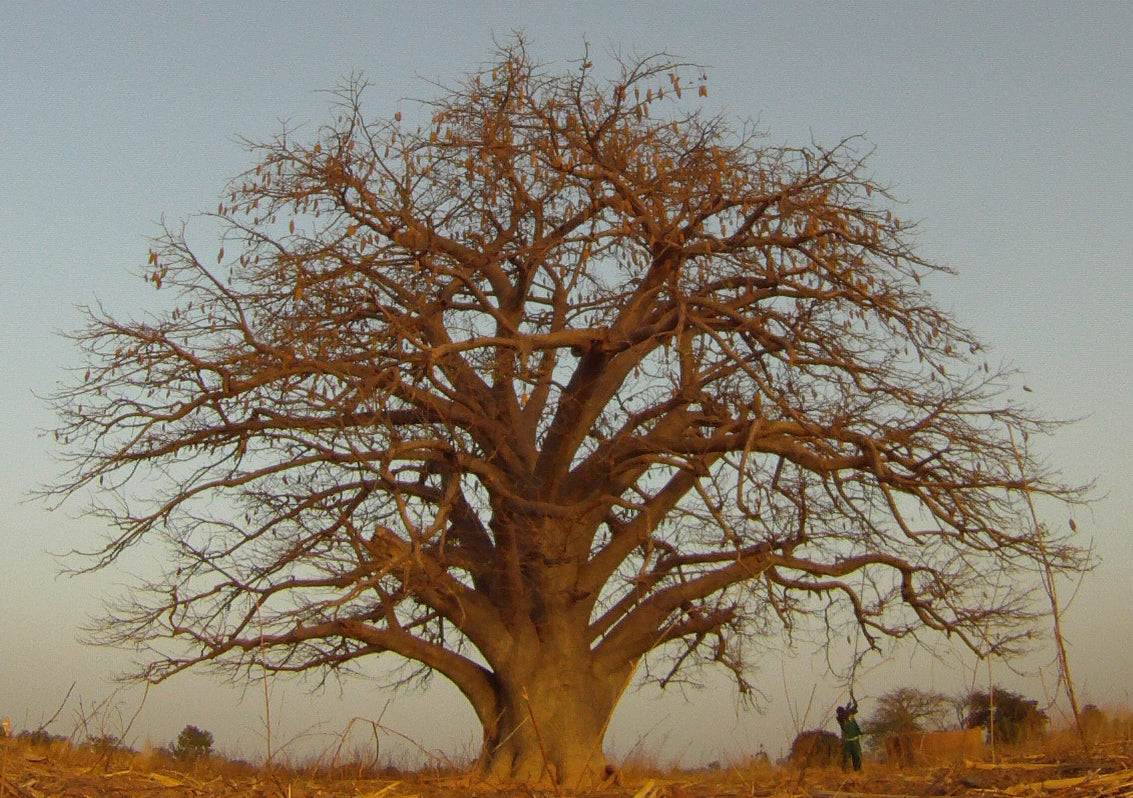
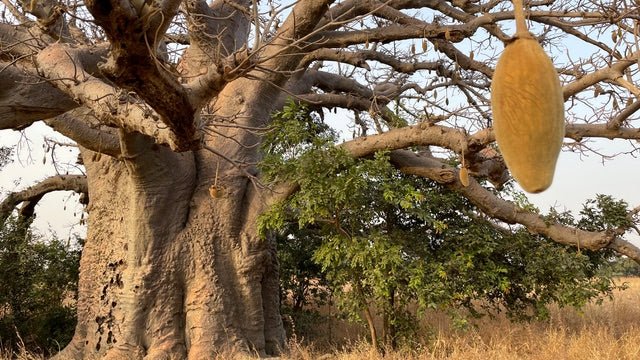
Evaluating baobab trees in the community
Other important uses of baobab income continue to include the purchase of livestock, clothing, and basic household goods such as soap, all of which contribute to household stability and resilience.
Key Observations and Trends Since 2020
-
Baobab remains the most important source of income across all communities and has become even more critical during the dry season.
-
The relative importance of farming as an income source has increased substantially, reflecting both necessity and economic pressure.
-
Rising temperatures, irregular rainfall patterns and ongoing land degradation continue to negatively impact crop health and yields.
-
Shea income has declined noticeably in recent years due to poor harvests, raising concerns about the localized impact of environmental change and long-term livelihood sustainability.
-
Market trading has become a more common income strategy as households diversify and adapt.
-
While education and health remain priority uses of baobab income, food purchases now account for a significantly larger share, pointing to rising food insecurity.
The 2025 participatory impact assessment confirms that baobab continues to play a central role in supporting livelihoods in KAIBAE’s partner communities. At the same time, the findings point to growing economic and environmental pressures that are reshaping how households earn and use income. Increased reliance on baobab to purchase food underscores both the importance of this income source and the rising vulnerability faced by rural households.
These findings reinforce the value of baobab tree conservation and sustained investment in the baobab supply chain, alongside complementary efforts to support food security, climate resilience, and diversified livelihoods in northern Ghana.


Published February 2026
For more information, contact: Barbara Berger Maes, KAIBAE, The Lost Crops Company Barbara@gokaibae.com #855-465-2422